
NWC NEWS ALERT (JUNE 23, 2026)
Navigating a Crowded Congressional Calendar
“No man is an island, entire of itself; every man is a piece of the continent, a part of the main.”
— John Donne, 1624
Last week, I was in St. Louis for the inaugural meeting of the Midwest Flood Control Association, made possible by the vision and hard work of Chuck Camillo and Tim Maiers. I was pleased to join Kirsten Wallace of the Upper Mississippi River Basin Association and Sunny Simpkins of the National Association of Flood and Stormwater Management Agencies for a panel discussion focused on a simple but important idea: no region, agency, or organization can afford to think only about its own piece of the map.
That is true in flood control. It is also true on Capitol Hill.
Congress is now in appropriations season. By law, all twelve annual spending bills are supposed to be enacted before September 30. In practice, that has not happened in more than thirty years. The challenge is not whether the federal government should be funded; it is how, at what levels, with what priorities, and under what conditions.
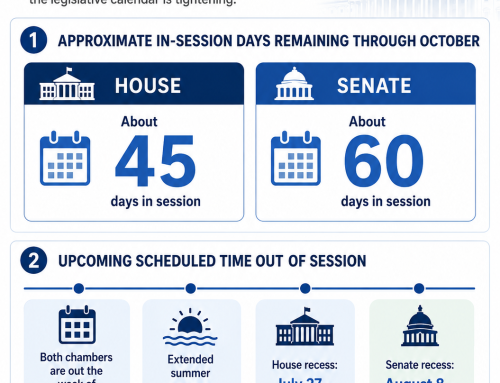
The calendar is tight. Before the August recess, the House and Senate have roughly 15 to 25 legislative days remaining, depending on the chamber. Once lawmakers return in September, they will have only about 12 to 14 legislative days before the new fiscal year begins on October 1.
This week, the House is expected to consider the FY 2027 Energy and Water Development Appropriations Act, H.R. 9022. The bill would provide $58.5 billion for the Department of Energy, the Army Corps of Engineers, and related agencies, including increases for nuclear security and continued support for Corps programs. The measure cleared the House Appropriations Committee in May and is slated to be considered by the House Rules Committee today and will hit the House floor later this week.
That is meaningful progress, but it is not the end of the process. The Senate has begun its appropriations work and will write their own versions. Any Senate bill must be able to clear the chamber’s 60-vote threshold, which creates a different set of political and policy considerations. Ultimately, the final bill will be whatever both chambers can negotiate and pass.
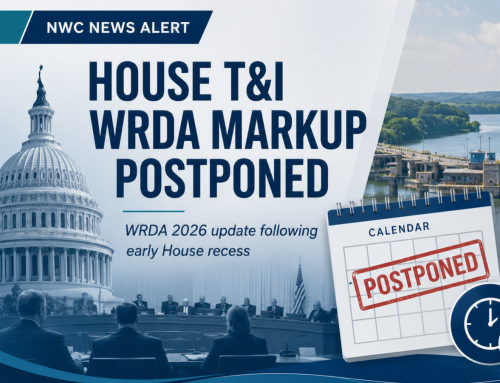
WRDA 2026 is also expected to be released “any day” now in the House Transportation and Infrastructure Committee, with Senate Environment and Public Works Committee introduction anticipated in July. Other appropriations bills remain in motion as well. The calendar is compressed, and the list of priorities is long.
In St. Louis, one question kept coming up: do you take a bite of the apple, or hold out for the whole thing and risk losing it altogether? There is no single answer. But the organizations making progress are the ones staying engaged, building relationships across chambers and across the aisle, and remembering that the finish line is shared even when the path is not.
That is what NWC is here to do.
More updates as they develop.
Julie Ufner, NWC
Resources
- Text of H.R. 9022
- House Appropriations Committee report for H.R. 9022
- List of proposed amendments for H.R. 9022 – Pending House Rules Committee actions
- List of included Community Project Funding requests