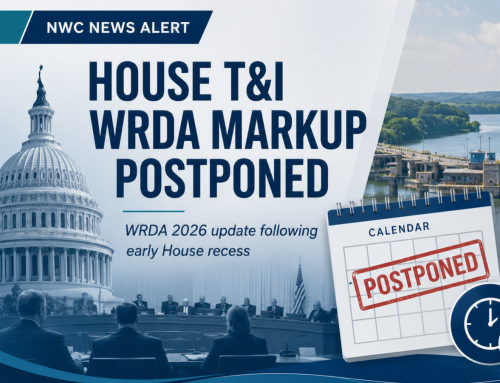

NWC NEWS ALERT (May 15, 2026)
Good morning NWC members,
Below is a modified Federal Spotlight news alert with several timely updates from Capitol Hill. I especially want to flag the House Energy and Water Development Appropriations Subcommittee markup scheduled for this morning, which is an important early step in the FY2027 appropriations process for programs of interest to NWC members. This alert also includes the latest on WRDA 2026, reconciliation activity, FEMA, agency updates, and other federal developments.
And because it is Friday, May 15, here is your very lightly useful fact of the day: May 15 is International Water Safety Day, a day focused on drowning awareness and helping people become safer in and around water. Not a bad reminder for a water resources crowd heading into summer.
As always, if you have questions, comments or concerns, please do not hesitate to reach out. Have a wonderful weekend!
Best,
Julie and the NWC Team
CAPITOL HILL SPOTLIGHT
Overview. Congress was out last week and returned this week. House and Senate appropriators are now actively working on fiscal year 2027 appropriations bills, with a number of draft bills released and markups scheduled over the next several weeks.
Current House composition stands at 217 Republicans to 212 Democrats and one Independent who is caucusing with the Republicans. Five seats remain vacant. This is a midterm election year, which means things are going to be fast and furious this summer – members are balancing legislative work with campaign activities, and floor time is at a premium.
With the 119th Congress ending at the end of the year, Congress has limited in-session days remaining. Between now and October, the House is scheduled for approximately 45 days in session and the Senate for approximately 60 days. The chambers are out the week of May 25, and both face extended recesses in July and August – the House is out from July 27 through August 30, and the Senate is out from August 8 through September 14. That compressed timeline matters for water policy: appropriations and reconciliation work will increasingly dominate the conversation, leaving limited bandwidth for standalone authorizing bills. NWC members should expect floor schedules to remain fluid and potentially unpredictable throughout the summer.
A quick reminder on Congressional retirements. Currently, 57 House members (37 Republicans, 20 Democrats) have announced their retirement, along with 10 senators. This represents the highest number of retirements in several decades. Of note to the water community, a number of these retirements come from the House Transportation and Infrastructure Committee, which means the 120th Congress starting in January 2027 will require considerable new Congressional member education and relationship building.
APPROPRIATIONS UPDATE
Fiscal Year 2026 Wrapped Up. FY 2026 appropriations was completed on April 30, 2026, when President Trump signed the DHS appropriations bill (P.L. 119-86), ending the 76-day DHS shutdown that began February 14. The final package provided full-year funding for most federal agencies through September 30, 2026. Department of Homeland Security funding took longer to resolve, but that too was eventually completed in late April.
President Releases his FY2027 Budget Request. On April 3, 2026, President Trump released his FY 2027 budget request. The budget proposes a 10 percent cut to non-defense discretionary spending and a 42 percent increase in defense spending, requesting $660 billion for non-defense programs and $1.5 trillion for defense programs.
For the U.S. Army Corps of Engineers, the budget requests $6.66 billion, a reduction of $3.77 billion (37 percent) below the FY 2026 enacted level of $10.44 billion. The request proposes a new “District Salaries and Expenses” account representing $2.43 billion (36 percent of the total request), separating district overhead from project accounts as part of what the administration calls a “District Salary Transparency initiative.” The request eliminates funding for environmental infrastructure assistance, the Corps Water Infrastructure Financing Program, and most Continuing Authorities Programs.
For the Bureau of Reclamation and Central Utah Project, the budget requests $1.3 billion, a reduction of approximately 22 percent below the FY 2026 enacted level. The request eliminates funding for the Bureau’s WaterSmart grants program. For more information, reference NWC News Alert (April 3, 2026) on the President’s FY2027 Budget Released.
As a reminder, the president’s budget request represents the administration’s wish list for funding levels and policy changes for the coming fiscal year. It is the opening salvo in the annual appropriations process. In some years, the budget is largely dead on arrival. In other years, Congress is more receptive to the administration’s proposals. Regardless of how closely Congress follows the president’s recommendations, the release of the budget request kickstarts appropriations activities on Capitol Hill, with congressional hearings and markup activity following shortly after.
Fiscal Year 2027 Appropriations Moving. The chambers are now working on FY 2027 appropriations bills, with several bills released in draft form.
- All FY27 House appropriations bill text and reports can be found at https://appropriations.house.gov/fy27-information/fy27-bill-text-and-reports(once available)
- The full markup schedule is available.
- If not posted, here is the draft House Energy and Water Development Bill
- Community project funding requests will be available at https://appropriations.house.gov/fy27-informationonce posted.
On Energy and Water Development appropriations (which funds the U.S. Army Corps of Engineers, Bureau of Reclamation and Department of Energy):
- The House subcommittee markup is scheduled for 9:00 AM ET on Friday, May 15, with full committee markup scheduled for May 20.
- The Senate Energy and Water Development Appropriations Subcommittee hearing on the President’s FY2027 budget request has been noticed for May 20. You can watch it
Additional appropriations activity includes:
- Commerce, Justice, Science and Related Agencies Bill: House subcommittee markup was held April 30. Full committee markup was held May 13. Bill text and reports available at https://appropriations.house.gov/subcommittees/commerce-justice-science-and-related-agencies-0
- Interior, Environment and Related Agencies Bill: House subcommittee markup scheduled for May 21 at 8:00 AM ET. Full committee markup scheduled for June 3 at 10:00 AM ET.
- Transportation, Housing and Urban Development and Related Agencies Bill: House subcommittee markup scheduled for May 21 at 8:00 AM ET (joint with Interior). Full committee markup scheduled for June 4.
House Appropriations Committee Chairman Cole has publicly stated his goal of moving all 12 FY2027 appropriations bills through the House Appropriations Committee and to the House floor before the August recess.
Known Appropriations Timing and Challenges. There is no firm timeline yet for moving appropriations bills through the full process. Major disagreements persist on both funding amounts and policy riders. Given the compressed legislative calendar and the fact that the federal fiscal year ends September 30, it is likely Congress will need to pass a continuing resolution to keep the government funded into the fall.
What happens after the November elections will depend largely on election outcomes. NWC members should expect appropriations work to continue dominating floor time throughout the summer, leaving authorizing legislation like WRDA with an increasingly narrow window for consideration.
RECONCILIATION 2.0
Republicans are working on a second reconciliation package, commonly referred to as “Reconciliation 2.0.”
Reconciliation 2.0 Timeline. The Senate passed the FY2026 budget resolution (S. Con. Res. 33) on April 23 by a vote of 50-48. The House subsequently passed the same resolution on April 29 by a vote of 215-211. The resolution instructs the House and Senate Judiciary and Homeland Security committees to submit reconciliation legislation by May 15 that would increase deficits by up to $70 billion each over the 2026-2035 period. As a concurrent resolution, S.Con.Res. 33 is an agreement between the House and Senate and does not require the president’s signature – the reconciliation bills drafted pursuant to these instructions will require presidential signature to become law.
Second Reconciliation Bill Status. On May 5, Senate Judiciary and Homeland Security committees released text of a $72 billion reconciliation package focused on immigration enforcement funding. The package includes $38.2 billion for ICE, $26 billion for offices under CBP (including $3.5 billion for border security technology and screening), $5 billion for DHS, $1.5 billion for the Justice Department, and $1 billion for the Secret Service related to security for President Trump’s ballroom project. The funding is generally provided for FY2026 and available through FY2029. Senate GOP leaders planned to bring the bill to the floor the week of May 18, though the legislation has become mired in debate over certain provisions including the ballroom-related Secret Service funding. Senate Democrats have vowed to challenge provisions that may violate the Byrd Rule.
Possible Third Reconciliation Bill. House Republicans are now discussing passing a third reconciliation bill before the August recess. In closed-door meetings on May 12, House GOP leaders and members discussed passing this additional party-line bill by the end of July. However, significant obstacles remain: the House is only in session for approximately 30 legislative days before summer recess begins July 23, and both chambers would need to approve an identical budget resolution – a process that took months during last year’s drafting of the “Big Beautiful Bill.”
Scope and Priorities. The second reconciliation bill focuses on ICE and Border Patrol funding that was excluded from the DHS appropriations bill. A potential third reconciliation bill could address additional priorities. The House Republican Study Committee has identified policy proposals for potential inclusion, including provisions related to permitting processes for energy projects, energy efficiency standards, fraud prevention, and federal grants and subsidies. The Senate’s Byrd Rule restricts reconciliation content to provisions with direct budgetary effects. Sen. Shelley Moore Capito (R-W.Va.), chair of the Senate Environment and Public Works Committee, has stated that permitting reform should not be addressed through the reconciliation process.
Note on the Byrd Rule. Reconciliation bills move under special budget rules that allow passage with a simple majority in the Senate. The Byrd Rule restricts reconciliation content to provisions with direct budgetary effects. The rule is named after the late Senator Robert C. Byrd (D-W.Va.), who first introduced it in 1985 to prevent extraneous provisions unrelated to the budget from being included in reconciliation bills. The rule was made permanent in 1990 when it was incorporated into the Congressional Budget Act as Section 313.
WATER RESOURCES DEVELOPMENT ACT OF 2026
Background. WRDA is the biennial authorization bill for U.S. Army Corps of Engineers (USACE) civil works studies, projects, and policies. It represents step one of the two-step process to get studies and projects authorized, then funded through the annual appropriations process.
WRDA Member Requests. Both chambers had member-only portals open earlier this year for WRDA 2026. The Senate Environment and Public Works Committee received over 1,200 requests and the House Transportation and Infrastructure Committee received over 2,000 requests. Many requests were duplicative across chambers. Both committees are now putting pen to paper and sending submissions to USACE to receive technical assistance and gain insight on how the Corps would interpret the policies and implement them.
WRDA Timing. Current expectations are that the Senate’s Environment and Public Works Committee and the House Transportation and Infrastructure Committee’s Water Resources and Environment Subcommittee could have a draft bill available in June, likely mid-June, with full committee action possible in the second half of the month, and floor action in the June/July timeframe. That timeline may shift based on other Congressional priorities.
WRDA House and Senate Bill Differences. The House and Senate will develop separate WRDA bills based on the distinct member requests each chamber received. Each committee evaluates requests through its own process and makes independent decisions about which projects and policies to include. As a result, the House and Senate bills may contain different projects, different policy provisions, and different policy priorities. This is not unusual, but once the bills are passed in their respective chambers, these differences must be reconciled through a conference committee process. The conference report will then need to pass both chambers in identical form before going to the president for signature, expected tentatively later this year.
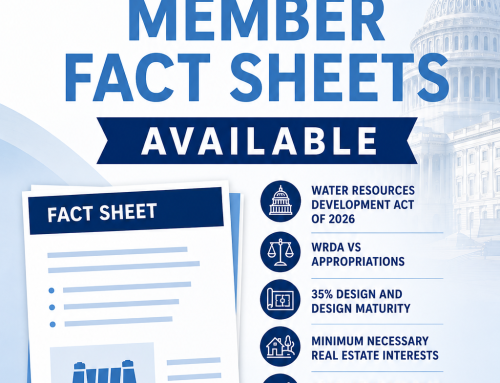
What to Watch: NWC Members should expect fewer new Chief’s Reports to be ready for inclusion this year. Currently, two Chief’s Reports (Columbia River Turning Basins Navigation Improvements, Washington and Oregon and Surf City, Onslow and Pender Counties, North Carolina, Coastal Storm Risk Management), along with two Director Memos (Central and Southern Florida, Canal 111 (C-111) South Dade Project and Memphis Metropolitan Stormwater) are listed on the House Transportation and Infrastructure Committee website, and fewer than 10 are expected total. The Corps’ implementation of a 35 percent design requirement within the feasibility study process has slowed the completion of some studies and will likely limit the number of new project authorizations available when WRDA is ready to move (NWC Fact Sheet on 35% design).
FEDERAL AGENCY ACTIVITY
Section 7001 Submission Period Opens. The U.S. Army Corps of Engineers opened the public comment period for the 2027 Section 7001 report on May 4, 2026. Submissions are due by September 1, 2026. These submissions will be included in USACE’s Section 7001 report to Congress scheduled for 2027.
Section 7001 of the Water Resources Reform and Development Act (WRRDA) of 2014 established an annual process for nonfederal interests to submit proposals for site-specific water resources studies and projects. The Assistant Secretary of the Army for Civil Works reviews submissions and transmits an annual report to the House Transportation and Infrastructure Committee and the Senate Environment and Public Works Committee. The report includes Chief’s Reports (completed feasibility studies) and nonfederal proposals. Congress has referenced Section 7001 reports when developing WRDAs enacted from 2016 through 2024. Inclusion in a Section 7001 report does not provide authorization or appropriation, but rather facilitates congressional consideration for potential inclusion in WRDA legislation.
NOAA and North Atlantic Right Whale Public Comment Period Open. NOAA Fisheries (National Marine Fisheries Service, or NMFS) is accepting public comments through June 2, 2026, on an advance notice of proposed rulemaking to amend the North Atlantic Right Whale Vessel Strike Reduction Rule. The advance notice was published on March 4, 2026. NMFS is soliciting information and comments on the effectiveness of technologies to reduce vessel strikes with whales, conservation efficacy of existing and potential vessel strike reduction measures, and successful models for mariner outreach and collaborative monitoring programs.
The notice also considers possible deregulatory action to modify and modernize the vessel speed rule to reduce regulatory and economic burdens on the regulated community by replacing current seasonal speed restrictions with alternative management areas and technology-based strike-avoidance measures. The current vessel speed rule, in place since 2008, requires vessels 65 feet and longer to travel at 10 knots or less in designated seasonal management areas where North Atlantic right whales and vessel traffic overlap.
EPA Lead and Copper Rule Update. The U.S. Environmental Protection Agency (EPA) released guidance in April 2026 (Service Line Inventories – Tips Fact Sheet and Service Line Replacement Access – Tips) outlining requirements and flexibilities for complying with the Lead and Copper Rule Improvements (LCRI). The guidance is intended to help water utilities meet the rule’s requirements.
EPA finalized the LCRI in October 2024. The rule requires drinking water systems to identify and replace all lead service lines within 10 years. The rule also lowers the lead action level from 15 parts per billion to 10 ppb and strengthens tap-sampling and public communication requirements. The compliance date is November 1, 2027, after which the 10-year replacement clock begins.
EPA estimates the total cost to replace all lead service lines could exceed $90 billion. The American Water Works Association estimates the cost could exceed $100 billion based on an average replacement cost of more than $12,000 per line. The Bipartisan Infrastructure Law allocated $15 billion specifically for lead service line inventories and replacement, with an additional $11.7 billion available through general Drinking Water State Revolving Funds that can also support lead pipe removal. EPA estimates there are approximately 9-9.2 million lead service lines still in use across the United States.
FEMA remains in the spotlight. The FEMA Review Council released its final report on May 7, 2026, with recommendations on the future structure and role of the Federal Emergency Management Agency (FEMA).
The central theme of the report is that disaster response should be “locally executed, state or tribally managed, and federally supported.” The Council recommends shifting greater responsibility to state, local, tribal, and territorial governments, while maintaining core federal capabilities for catastrophic events and national coordination.
The report calls for changes to federal disaster declaration criteria, including a greater focus on whether an event exceeds state, tribal, territorial, or local capacity. It also recommends replacing several existing FEMA assistance programs with faster, more direct funding models, including proposed reforms to Individual Assistance, Public Assistance, and hazard mitigation funding. Other major themes include reducing administrative costs, modernizing technology, improving national resource coordination, strengthening preparedness standards, and reforming the National Flood Insurance Program through updated risk data, risk-based pricing, and greater private-sector participation.
For water resources and flood-risk stakeholders, what happens as a result of the report is worth watching closely. Several recommendations could affect how communities receive post-disaster recovery funding, how mitigation dollars are distributed, how flood risk is priced and communicated, and how federal, state, and local responsibilities are balanced after major disasters. The report is advisory, and several recommendations would require legislative or regulatory action before implementation.
FEMA Leadership Nomination. President Trump has nominated Cameron Hamilton, of Virginia, to serve as Administrator of the Federal Emergency Management Agency within the Department of Homeland Security. The nomination was sent to the Senate on May 11 and requires Senate confirmation. Hamilton previously served as FEMA’s acting administrator in 2025, and his nomination comes as the Administration and Congress are considering broader questions about FEMA’s structure, mission, and future role in disaster response. In the interim, Robert Fenton Jr. is serving as acting FEMA administrator after the previous acting FEMA administrator, Karen Evans, stepped down earlier this week. Fenton is a 30-year FEMA veteran who also served on the FEMA Review Council.
GAO Report on Clean Water Act Mitigation. On April 30, the Government Accountability Office released a report finding that the U.S. Army Corps of Engineers has improved its oversight of compensatory mitigation under the Clean Water Act, but needs to provide implementation guidance to districts. The report examines how the Corps tracks and monitors mitigation sites used to offset unavoidable impacts to wetlands and streams from permitted activities.