
NWC FEDERAL SPOTLIGHT
March 16, 2026
Hello NWC Members,
March marks the start of a busy stretch for federal policymaking. Congress is turning its attention to fiscal year (FY) 2027 appropriations while continuing oversight of federal infrastructure programs, including the U.S. Army Corps of Engineers Civil Works program. The Administration is expected to release the FY2027 President’s Budget later this month, which will provide the first detailed look at proposed funding levels and priorities for water resources infrastructure across the federal government.
At the same time, committees in both chambers have begun holding hearings that may inform development of the next Water Resources Development Act (WRDA). Early discussions have focused on project delivery timelines, the role of non-federal sponsors, and opportunities to improve planning and permitting processes.
Several developments across the executive branch and the courts are also shaping the federal water policy landscape. The Administration recently announced a U.S. Army Corps of Engineers (USACE/Corps) reform initiative aimed at accelerating Civil Works project delivery, while federal courts continue to address litigation affecting dam operations in the Pacific Northwest. Federal agencies are also considering regulatory changes related to PFAS drinking water standards and other environmental policies.
This month’s Federal Spotlight highlights recent congressional activity, updates on FY2026 and FY2027 appropriations, early WRDA-related discussions, and several executive branch and judicial developments affecting water resources infrastructure.
Behind the scenes, NWC has been working actively on your behalf:
- Completed WRDA 2026 Hearing Follow-Up. NWC recently submitted responses to several Questions for the Record (QFRs) (Babin and Hurd QFRs) following the December congressional hearing on the Water Resources Development Act of 2026. The responses were transmitted last month and provide detailed information and perspectives on a range of water resources policy issues discussed during the hearing. Thanks to everyone who provided feedback!
- Engaging with GAO on WRDA Provisions and Ongoing Studies. NWC staff have met several times with the Government Accountability Office (GAO) regarding provisions included in previous WRDA legislation. Last week, NWC discussed GAO’s ongoing work examining changes to the NEPA process; nonfederal sponsor land acquisition responsibilities and the Corps’ determination of land interests and use of easements for its projects; and how hazardous sites can affect the advancement of Corps projects. GAO is interested in hearing from project sponsors and stakeholders about their experiences, and NWC is happy to connect interested members with GAO staff. In addition, GAO has contacted NWC regarding several other ongoing studies where member perspectives may be helpful – including the Corps Disaster Response and PL 84-99; Examine the use of technology and practices within the design, study, and planning phases of water development projects; Corps policies under NEPA; Corps process on land interests for flood risk management and ecosystem restoration projects; and impact of hazardous contamination for Corps civil works projects.
- NWC recently flagged the Administration’s “Building Infrastructure, Not Paperwork” (BINP) initiative and a subsequent series of ASACW memoranda providing direction to USACE on implementing elements of the initiative across the Civil Works program. The memoranda address several policy and programmatic issues, including project prioritization, Section 408 permissions, mitigation banking for dredging, potential project deauthorizations, expanded use of non-federal capabilities, and opportunities for non-federal investment at Corps facilities. Members can read more in NWC’s February 24 and March 4 News Alerts.
Planning for the NWC Legislative Summit continues, and updated speaker information is becoming available. Members are encouraged to check the NWC website for the latest agenda and confirmed speakers. NWC will host a joint program with the Pacific Northwest Waterways Association (PNWA) on April 21, and a number of high-level agency speakers for that day have already confirmed their participation. The agendas for the half-day sessions on April 20 and April 22 are still being finalized, although on April 22, NWC is planning a “Corps 101” workshop focused on the practical “insider baseball” aspects of working with the U.S. Army Corps of Engineers and navigating Corps programs.
Later this month, NWC leadership will meet with the Board of Directors to discuss a potential adjustment to NWC dues. The proposal is still under development and remains in the early stages of discussion. Additional information will be shared with members as those discussions move forward.
As always, thank you for your engagement and support.
Best,
Julie and the NWC Team
NWC MEMBER SPOTLIGHT
NWC Welcomes New Member – The Northwest Seaport Alliance. NWC welcomes The Northwest Seaport Alliance as its newest member. The Northwest Seaport Alliance is the marine cargo operating partnership of the ports of Seattle and Tacoma and serves as a major gateway for international trade in the Pacific Northwest, supporting containerized cargo movement, regional economic development and global supply chains. The alliance manages marine cargo operations across both ports and works with shipping lines, terminal operators, and logistics partners to facilitate efficient freight movement and strengthen the region’s trade competitiveness. NWC looks forward to working with The Northwest Seaport Alliance on issues affecting ports, navigation, and the nation’s inland and coastal waterway infrastructure. NWC official liaisons for the organization will be Ryan McFarland and Emily Rankin.
American Shore and Beach Preservation Association – National Coastal Summit.
(March 24-26, 2026, Washington, DC).
The American Shore and Beach Preservation Association (ASBPA) will hold its National Coastal Summit on March 24-26, 2026, in Washington, DC, bringing together coastal engineers, planners, and policy professionals to discuss shoreline management, coastal resilience, and federal coastal infrastructure programs. Topics are expected to include beach nourishment, coastal storm risk management, ecosystem restoration, and federal policies affecting coastal infrastructure.
Former NWC Chair Randy Richardson to Retire After 25 Years at Memphis Port. Randy Richardson, Executive Director of the Memphis & Shelby County Port Commission and Vice President of Port and Industrial Properties at EDGE, has announced that he will retire on December 31, 2026, after more than 35 years of service advancing port development and industrial growth along the Mississippi River. Richardson has helped guide the planning, development and operation of port and industrial assets that support more than 120 industries and billions of dollars in regional investment. He is also well known within the waterways community as a past chairman of the National Waterways Conference and former chairman of Inland Rivers, Ports and Terminals. While a formal search has not yet begun, the Port Commission has asked that news of his upcoming retirement be shared so that potential candidates may begin considering the opportunity. Congratulations Randy!
Former NWC Staff Member Joins Pacific Northwest Waterways Association. After nearly a year of part-time work with NWC, Nicole Kach recently departed to begin a full-time position with the Pacific Northwest Waterways Association. She started her new role last week. While we will miss Nicole, we are glad she will remain in the waterways community and wish her all the best at PNWA. Congratulations Nicole!
CONGRESSIONAL SPOTLIGHT
OVERVIEW. Congress continues to operate in a challenging legislative environment shaped by a narrow Republican majority in the House and the Senate’s 60-vote threshold required to advance most legislation. These dynamics often require bipartisan cooperation to move major legislation and can affect both the pace and scope of policymaking.
At the same time, lawmakers are balancing several competing priorities, including completing the remaining FY2026 appropriations work and beginning the FY2027 budget cycle. Broader geopolitical developments – including recent U.S. military strikes in Iran – have also drawn congressional attention to national security and foreign policy issues, which may influence floor time and the legislative calendar in the coming weeks.
Spring primary elections are also beginning in several states, and attention is gradually shifting toward the 2026 election cycle. As the year progresses, these dynamics may further shape legislative timelines and the availability of floor time for authorization and appropriations legislation.
The House was out last week. House Republicans held their annual policy retreat in Florida last week. Both the House and Senate are scheduled to be in session this week.
House and Senate Retirements Continue to Grow. Retirement announcements continue to accumulate as the 2026 election cycle approaches. As of early March, 57 House members (21 Democrats and 36 Republicans) and 10 senators (four Democrats and six Republicans) have announced they will not seek reelection. According to Ballotpedia, at this point in the last four election cycles, there were 42 House retirement announcements in 2024, 45 in 2022, 34 in 2020, and 46 in 2018 and, in the Senate, there were eight in 2024, six in 2022, four in 2020, and three in 2018. While these departures will not affect the balance of the current 119th Congress, they will shape committee rosters and leadership when the 120th Congress convenes in early 2027. Among those retiring are members who currently serve on committees with jurisdiction over infrastructure and water resources policy, including Sen. Cynthia Lummis (R-Wyo.), of the Senate Environment and Public Works Committee, and Rep. Burgess Owens (R-Utah), and Rep. Julia Brownley (D-Calif.), of the House Transportation and Infrastructure Committee. Changes in membership on these committees can influence leadership roles, subcommittee assignments and the experience base available for future authorization and oversight work.
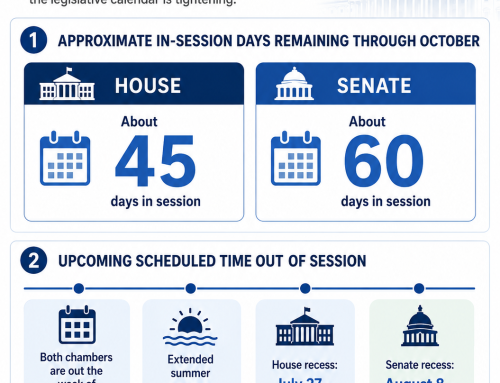
Fiscal Year 2026 Appropriations. Where Things Stand. Congress has not yet finalized fiscal year 2026 appropriations for the Department of Homeland Security, leaving the department without a full-year funding agreement as negotiations continue. The delay reflects ongoing disagreements over immigration and border enforcement policy, particularly funding levels and policy provisions related to U.S. Immigration and Customs Enforcement. The Senate’s published tentative schedule shows a state work period from March 30 through April 10, and the House calendar indicates the chamber is not scheduled to return until the week of April 13, narrowing the window for lawmakers to resolve the issue before the recess and potentially pushing action further into April.
Although public attention has focused largely on ICE, DHS funding supports a much broader set of agencies and programs with direct relevance to transportation, infrastructure and emergency response. These include the U.S. Coast Guard’s maritime safety, navigation and port security missions; FEMA disaster response and recovery programs; cybersecurity efforts to protect critical infrastructure; and the Transportation Security Administration’s aviation and transportation security responsibilities. As a result, continued uncertainty over DHS appropriations has implications that extend well beyond immigration enforcement.
Turning the Page to FY 2027 Appropriations. Attention on Capitol Hill is increasingly turning toward the FY2027 budget cycle. The White House is tentatively targeting the week of March 30 for release of the President’s FY2027 budget proposal, according to recent reporting. Once released, the President’s Budget often helps shape early appropriations discussions and priorities on Capitol Hill. House appropriators have also announced adjustments to the rules governing congressionally directed spending requests. Members will now be permitted to submit up to 20 project requests, an increase from the previous limit of 15. Total earmark spending will remain capped at 1 percent of discretionary spending, divided evenly between the House and Senate.
Resources:
- House Appropriations Committee guidance on programmatic and language requests
- House Appropriations Committee guidance on community project funding
- House Appropriations Committee’s list of eligible accounts for community project funding
Water Resources Development Act of 2026: Status Update. The WRDA 2026 process is now underway. The process began late last year with a stakeholder hearing held by the House Transportation and Infrastructure Committee, where NWC provided testimony outlining priorities for the upcoming authorization cycle.
Earlier this year, both the House Transportation and Infrastructure Committee and the Senate Environment and Public Works Committee opened member-only portals for WRDA proposals, which closed on Feb. 6. Congressional offices submitted more than 1,000 proposals across the two committees. Committee staff are currently reviewing submissions and working to identify duplications and consolidate similar proposals as they begin developing legislative language.
Both committees also held WRDA oversight hearings during the week of Feb. 23 featuring Assistant Secretary of the Army for Civil Works (ASACW) Adam Telle and U.S. Army Corps of Engineers Commanding General Lt. Gen. William “Butch” Graham. Members used the hearings to examine priorities for the upcoming WRDA bill and asked numerous questions regarding implementation of recent WRDA provisions, Corps project delivery timelines and the administration’s October announcement regarding pauses affecting certain water resources projects.
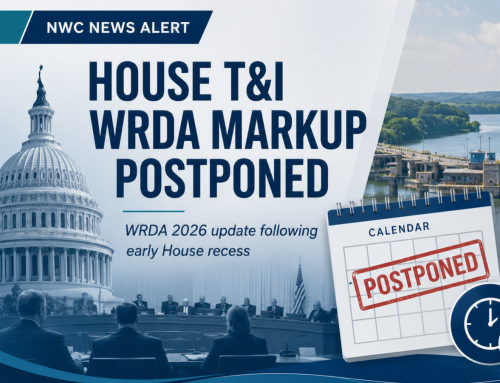
Concurrent with these developments, ASACW Telle released a series of memoranda last week outlining direction for implementing elements of the Administration’s “Building Infrastructure, Not Paperwork” initiative. These memoranda may influence both the WRDA process and the implementation of Civil Works projects moving forward. NWC summarized and linked to these memoranda in a March 4 News Alert.
House Agriculture Committee Advances Farm Bill. The House Agriculture Committee approved the Farm, Food, and National Security Act of 2026 (H.R. 7567), advancing the chamber’s Farm Bill reauthorization. The legislation addresses farm safety net programs, conservation initiatives, nutrition assistance and rural development policies intended to support agricultural producers and strengthen domestic food production. The bill now heads to the full House for consideration, while the Senate Agriculture Committee continues developing its own Farm Bill proposal.
Resources:
Reconciliation 2.0? House Republican leaders are considering pursuing a second budget reconciliation package this year, though the effort remains uncertain and lacks clear policy details. Speaker Mike Johnson has pushed the idea following discussions at the House GOP retreat in Florida, arguing that Republicans should take advantage of remaining time in the current Congress to advance additional legislation through the fast-track process that only requires a simple majority in the Senate. However, many Republican leaders and lawmakers are skeptical that a second package is feasible given the party’s narrow one-vote majority in the House and disagreements over spending cuts needed to offset new policies. Conservatives are expected to demand that any new spending be fully offset, while moderates may resist deep reductions to federal programs. Possible policy ideas discussed include defense funding, tax credits for first-time homebuyers and efforts to address government program fraud, but no consensus has emerged. Some Republican leaders have suggested focusing instead on smaller legislative measures, while others argue another reconciliation package could help advance key priorities before the election.
TSCA Fee Reauthorization Discussion Draft. The Senate Environment and Public Works Committee recently released a discussion draft of the “Toxic Substances Control Act Fee Reauthorization and Improvement Act of 2026.” The proposal would update EPA’s chemical review framework ahead of the September expiration of the agency’s authority to collect fees supporting chemical safety reviews.
While the proposal does not establish PFAS-specific standards, TSCA governs EPA’s evaluation of industrial chemicals, including per- and polyfluoroalkyl substances, and could influence how PFAS are evaluated, prioritized and regulated. A hearing was held on March 4 to dig into the proposal.
Latest News on Permitting Reform. Senate Democrats have agreed to resume bipartisan negotiations on federal permitting reform after previously pausing talks late last year amid disputes with the Trump administration over actions affecting renewable energy projects. Senate Environment and Public Works Committee ranking member Sheldon Whitehouse (D-R.I.) and Energy and Natural Resources Committee ranking member Martin Heinrich (D-N.M.) had stepped away from negotiations following Interior Department actions blocking several offshore wind projects and halting approvals for some solar developments. The senators said they returned to the negotiating table after the administration indicated it was processing applications for solar and onshore wind projects. Committee leaders in both parties have said they hope to develop bipartisan legislation to address federal permitting processes, including reviews under the National Environmental Policy Act, though prospects remain uncertain in an election year. The House previously passed the “Standardizing Permitting and Expediting Economic Development (SPEED) Act,” H.R. 4776, which would revise environmental review procedures and limit certain litigation, but the bill received limited Democratic support.
Bill Introduced in the House to Establish Coastal Storm Risk Management Trust Fund.
Rep. Jeff Van Drew (R-N.J.) introduced bipartisan legislation to create a dedicated funding source for coastal storm risk management projects carried out by the U.S. Army Corps of Engineers. The bill, the Coastal Trust Fund Act (H.R. 7459), would establish a Coastal Storm Risk Management Trust Fund in the U.S. Treasury funded by $1 billion annually from Outer Continental Shelf oil and gas revenues, along with investment earnings. Funds would be available for the federal share of the construction, operation, maintenance, repair, rehabilitation and periodic nourishment of congressionally authorized coastal storm risk management projects, including hurricane and storm damage reduction and shoreline protection efforts. The legislation also requires annual reporting to Congress on expenditures and projects supported by the fund. The bill has been referred to the House Committee on Transportation and Infrastructure.
Bill Introduced to Establish Federal Board to Review Major Weather Disasters. Rep. Eric Sorensen (D-Ill.) introduced legislation in the House that would establish an independent board to investigate major weather disasters and identify lessons that could improve forecasting, emergency response and disaster preparedness. The bill, the Disaster Learning and Life Saving Act (H.R. 7848), would create a Weather Safety Review Board modeled in part on the National Transportation Safety Board, which investigates transportation accidents and issues safety recommendations. Sorensen, a former broadcast meteorologist, said the legislation is intended to ensure the federal government systematically examines major disasters such as floods, hurricanes and tornado outbreaks to understand what happened and how future impacts could be reduced. Under the bill, the board would conduct investigations following significant weather disasters and produce public reports with recommendations for federal, state and local agencies. The legislation has been referred to the House Committee on Science, Space and Technology, which has jurisdiction over the National Weather Service and related forecasting activities. Similar proposals have been introduced in previous Congresses but have not been enacted.
CONGRESSIONAL RESEARCH SERVICE: RECENT REPORTS OF INTEREST.
The Congressional Research Service (CRS) is a nonpartisan legislative support agency within the Library of Congress that provides confidential policy analysis, legal interpretation, and research to Members of Congress and congressional staff. CRS reports and briefings are designed to support legislative decision-making across a wide range of policy areas.
Below are several recent CRS reports of interest:
- 1944 U.S.-Mexico Water Treaty: Issues in the 119th Congress (March 6, 2026).
- Introduction to the National Flood Insurance Program (NFIP) (March 5, 2026).
- Navigating the Appropriations Status Table (March 3, 2026).
- Local and Regional Project Assistance Program: Background and Selected Considerations (Feb. 25, 2026).
- The U.S. Geological Survey (USGS): FY2026 Appropriations (Feb. 23, 2026).
- The Reconciliation Process: Frequently Asked Questions (Feb. 23, 2026).
- Coastal Zone Management Act (CZMA): Overview and Issues for Congress (Feb. 19, 2026).
- FEMA’s Building Resilient Infrastructure and Communities (BRIC): Recent Developments (Feb. 19, 2026).
- Agriculture and Related Agencies: FY2026 Appropriations (Feb. 17, 2026).
- Bureau of Reclamation WaterSMART Program (Feb. 12, 2026).
- Supreme Court Decisions Without a Majority (Feb. 10, 2026).
- What Happens If the National Flood Insurance Program (NFIP) Lapses? (Feb. 6, 2026).
- U.S. Army Corps of Engineers: FY2026 Appropriations (Feb. 6, 2026).
- Bureau of Reclamation Support for Water Storage Projects (Feb. 6, 2026).
Upcoming Hearings and Markup of Interest
- Pier Pressure: Regulation and Competition in Maritime Shipping (Tuesday, March 17, 2026, 10:00am ET). House Judiciary Subcommittee on Administrative State, Regulatory Reform, and Antitrust.
- Hearings to examine the nomination of Markwayne Mullin, of Oklahoma, to be Secretary of Homeland Security (Wednesday, March 2026, 9:30am ET). Senate Committee on Homeland Security and Governmental Affairs.
- Hearings to examine challenges and opportunities with implementing the Endangered Species Act (Wednesday, March 18, 2026, 10:00am ET). Senate Environment and Public Works Subcommittee on Fisheries, Wildlife, and Water.
JUDICIAL SPOTLIGHT
Court orders FEMA to restore disaster mitigation funding.
A federal judge on March 6, 2026, ordered the Federal Emergency Management Agency to begin restoring funding for the Building Resilient Infrastructure and Communities program after finding the agency had not complied with a prior court ruling. The order enforces a December 11, 2025, decision by the U.S. District Court for the District of Massachusetts that determined FEMA’s termination of the pre-disaster mitigation program was unlawful. The court directed FEMA to take steps to make mitigation funding available again, provide information to affected applicants regarding the status of previously selected projects and report back to the court on actions taken to comply with the ruling. The administration has challenged the ruling and is seeking appellate review.
Supreme Court Limits Presidential Authority to Impose Tariffs.
The U.S. Supreme Court ruled that the president does not have authority under the International Emergency Economic Powers Act (IEEPA) to impose broad import tariffs without congressional approval. In Learning Resources, Inc. v. Trump, No. 24-1287 (U.S. Feb. 20, 2026), the Court held in a 6–3 decision that the statute allows the president to regulate certain economic transactions during national emergencies but does not authorize the unilateral imposition of tariffs, which are traditionally set by Congress. The ruling invalidated a series of tariffs imposed under emergency authorities and could lead to significant refunds for importers that paid duties under those measures. The decision has implications for sectors dependent on international trade and logistics, including maritime shipping and port operations, because tariffs directly affect import volumes, cargo flows, and supply chains moving through U.S. ports and inland waterways.
Court Orders Continued Salmon-Protective Operations at Columbia and Snake River Dams. A federal judge in the U.S. District Court for the District of Oregon ordered federal agencies to continue operating dams on the Columbia and Snake rivers under spill and flow measures intended to support endangered salmon and steelhead populations while litigation over the federal hydropower system proceeds. The order was issued in National Wildlife Federation v. National Marine Fisheries Service, No. 3:01-cv-00640-SI (D. Or.), a long-running case challenging federal management of the Columbia River System under the Endangered Species Act. The ruling requires agencies to maintain 24/7 spill operations designed to assist fish migration at 14 federal dams while the case continues. The litigation resumed after the administration withdrew from the Resilient Columbia Basin Agreement, which had paused the case for several years while federal agencies, tribes, and the states of Oregon and Washington pursued settlement discussions. Federal agencies and project operators argued that expanded spill requirements could affect hydropower generation, irrigation operations, navigation, and grid reliability. The court concluded that the order largely maintains existing spill levels from 2025 and declined to stay the requirements pending appeal. The defendants are evaluating appeals options.
FEDERAL GOVERNMENT SPOTLIGHT
ADMINISTRATION
State of the Union Address. President Donald Trump delivered his 2026 State of the Union address to a joint session of Congress on February 24, 2026. The address lasted approximately 1 hour and 47 minutes, making it the longest State of the Union speech in U.S. history.
The speech largely focused on the administration’s economic agenda, immigration policies, and national security priorities. Trade policy and tariffs were a recurring theme. President Trump reiterated support for broad tariff policies aimed at addressing U.S. trade imbalances and generating federal revenue, including proposals for new baseline tariffs on imports. The speech came just days after a U.S. Supreme Court ruling that limited the administration’s authority to impose certain tariffs under emergency powers.
While the address covered a wide range of domestic and international issues, water resources infrastructure, inland waterways, and ports were not a major focus of the speech. However, the president emphasized economic competitiveness, supply chains, and domestic manufacturing – issues that can affect freight movement, ports, and maritime transportation systems that depend on federal water infrastructure investments.
The address also highlighted broader administration priorities including economic growth, energy production, border security, and defense spending, while outlining policy proposals the administration hopes Congress will consider during the remainder of the 119th Congress.
Federal Workforce Reductions, Personnel Policy Changes, and Office Consolidation. The Trump administration continues to pursue efforts to reduce and restructure the federal workforce through layoffs, hiring changes, and new personnel policies. Recent reporting indicates that more than 387,000 federal employees have left government service since the start of the administration through firings, layoffs and buyouts, even as the administration has begun selectively rehiring for some roles and adjusting its hiring approach. Reporting also indicates that the administration is centralizing more hiring decisions and expanding the role of political leadership in recruitment for parts of the civilian workforce.
At the same time, the Office of Personnel Management has proposed new regulations that would revise how agencies conduct reductions in force. The proposal would place greater weight on an employee’s three most recent performance ratings when determining retention during layoffs, rather than relying primarily on tenure, and would also expand the categories of employees excluded from certain RIF procedures. Comments on the proposal are due May 4.
Separately, the administration is moving toward final implementation of Schedule Policy/Career, a new personnel classification for certain policy-influencing positions that would move affected employees into the excepted service and outside some traditional civil service protections. Federal News Network reported that OPM estimated the policy could apply to about 50,000 career employees, though that figure remains disputed.
Those personnel changes are now the subject of ongoing litigation. According to Federal News Network, a coalition of unions and public service organizations has challenged Schedule Policy/Career in court, arguing that the policy exceeds presidential authority, conflicts with federal civil service law, and violates due process protections. The lawsuit was updated following OPM’s February 6 final rule and comes as the administration moves closer to formal employee conversions under the new classification.
In parallel with workforce changes, agencies and policymakers are also examining ways to reduce federal facility costs by consolidating office space and reducing the federal real estate footprint. Recent reporting indicates that some departments, including the U.S. Department of Agriculture, are evaluating plans to vacate large office buildings in Washington, D.C., and relocate some staff to offices in other parts of the country. Separately, a federal advisory panel recently concluded that a significant reduction in buildings owned by the General Services Administration may be necessary to address a growing backlog of deferred maintenance across the federal property portfolio. Stakeholders are monitoring these developments for potential impacts on federal agencies involved in water resources infrastructure and related federal programs.
___________________________________________________________
DEPARTMENT OF AGRICULTURE
NOMINATIONS REQUESTED. USDA Reopens Nominations for Tribal Advisory Committee (Nominations due March 31, 2026).
USDA published a notice reopening the nomination period for membership on the USDA Tribal Advisory Committee. The department is seeking nominations to fill three vacancies on the 11-member committee. Nominations must be submitted by March 31, 2026. The Tribal Advisory Committee was established under the Agriculture Improvement Act of 2018 to advise the Secretary of Agriculture on matters relating to Tribal and Indian affairs affecting American Indian, Alaska Native and Native Hawaiian communities. Members serve three-year terms, and the notice states that the new appointments are expected to begin in spring 2026 rather than December 2025 as previously indicated. Eligible nominations may be submitted by authorized representatives of federally recognized tribes, tribal organizations or national or regional organizations with expertise in Tribal issues. Nomination packages must include a nomination letter describing the candidate’s qualifications, a resume and a completed advisory committee background information form.
____________________________________________________________
BUREAU OF RECLAMATION
NOTICE. Quarterly Status Report of Water Service, Repayment, and Other Water-Related Contract Actions.
Reclamation published its quarterly notice summarizing proposed, modified, discontinued, and completed water service and repayment contract actions across Reclamation regions. The notice is issued pursuant to section 9(f) of the Reclamation Project Act of 1939 and informs the public about contract negotiations and actions related to the delivery of project water and management of federal water infrastructure. The March 5 notice lists contract actions across the Missouri Basin, Upper Colorado Basin, Lower Colorado Basin, Columbia-Pacific Northwest and California-Great Basin regions. Reported actions include new contracts, contract renewals, assignments of water entitlements, repayment agreements related to dam safety modifications and revisions to existing water delivery contracts. Among the items listed are a proposed assignment of 1,100 acre-feet per year of Colorado River water from Beattie Farms Southwest to the Hualapai Tribe in Arizona; agreements involving storage water from Hungry Horse Reservoir for the Confederated Salish and Kootenai Tribes of the Flathead Reservation in Montana; and repayment contracts associated with Safety of Dams modifications at Kachess Dam in Washington. The notice also documents completed contract renewals and amendments involving irrigation districts, water conservancy districts, and municipal water users in several western states. Reclamation publishes these quarterly reports to provide transparency regarding ongoing contract negotiations and water delivery agreements tied to federal water projects.
FUNDING OPPORTUNITY. Small-Scale Water Efficiency Projects.
(Applications Due June 2, 2026).
On March 5, 2026, the Bureau of Reclamation announced funding for WaterSMART Small-Scale Water Efficiency Projects. The program supports projects that conserve water and improve water supply reliability in water delivery systems, including canal lining or piping, municipal metering improvements, irrigation flow measurement, SCADA installation, and landscape irrigation efficiency measures. Reclamation expects to award up to $4 million in total funding, with a federal award ceiling of $125,000 per project and a 50 percent nonfederal cost share requirement. Reclamation will host a webinar on the funding opportunity March 19, 2026, at 9 a.m. PT.
FUNDING OPPORTUNITY. Applied Science Grants.
(Applications Due July 8, 2026).
On March 5, 2026, the Bureau of Reclamation announced funding for WaterSMART Applied Science Grants. The program provides funding to nonfederal entities to develop tools and information that support water management decisions, including modeling and forecasting tools, hydrologic data platforms and new data sets. Reclamation expects to award approximately $6 million in total funding, with a federal award ceiling of $400,000 per project and a 50 percent nonfederal cost share requirement.
FUNDING OPPORTUNITY. Drought Response Program.
(Applications Due July 28, 2026).
On March 5, 2026, the Bureau of Reclamation announced funding through the WaterSMART Drought Response Program. The program supports projects designed to increase water management flexibility and reliability to help entities prepare for and respond to drought and water supply shortages. Eligible projects may include construction or infrastructure improvements, groundwater recharge, water reuse, drought contingency planning and other water management tools. Reclamation expects to award approximately $13.5 million in total funding, with a federal award ceiling of $1.5 million per project and a 50 percent nonfederal cost share requirement.
FUNDING OPPORTUNITY. Large-Scale Water Recycling Projects.
(Applications Due May 13, 2026).
On March 12, 2026, the Bureau of Reclamation announced funding for Large-Scale Water Recycling Projects through the WaterSMART program. The funding supports major water recycling projects with a minimum total project cost of $500 million. Reclamation expects to make approximately $130 million available, with a federal award ceiling of $130 million per project and a 75 percent nonfederal cost share requirement.
COMMENTS REQUESTED. Bureau of Reclamation Seeks Public Comment on Renewal of Recreation Survey Information Collection.
(Comments Due March 27, 2026).
Reclamation published a notice requesting public comment on the proposed renewal of an information collection titled “Recreation Survey Questions” (OMB Control Number 1006-0028). The collection supports surveys of visitors at recreation sites located on Reclamation-managed reservoirs and lands. Comments are due March 27, 2026. The surveys are intended to gather information on visitor demographics, recreation preferences, and visitor experiences to help the agency plan and manage recreation programs and facilities. Reclamation manages more than 240 recreation areas across 17 Western states, which receive approximately 40 million visitors each year. Reclamation estimates approximately 696 respondents annually, with an estimated total reporting burden of about 140 hours. The surveys would be conducted on a voluntary basis and generally take about 15 minutes to complete.
____________________________________________________________
DEPARTMENT OF STATE
PUBLIC MEETING. Preparatory Discussion for International Maritime Organization Legal Committee Session.
(April 2, 2026).
The Department of State will hold a public teleconference on April 2, 2026, at 10:00 a.m. ET to prepare for the 113th session of the International Maritime Organization Legal Committee, scheduled for April 13–17, 2026, in London. The meeting will discuss agenda items expected before the committee, including implementation of the 2010 Hazardous and Noxious Substances Protocol, fair treatment of seafarers, maritime autonomous surface ships, piracy and armed robbery against ships, and issues related to fraudulent ship registries. Additional topics include technical cooperation on maritime legislation, the status of conventions developed by the Legal Committee and other legal matters affecting international shipping.
PUBLIC MEETING. Preparatory Discussion for International Maritime Organization Marine Environment Protection Committee Session
(Wednesday, April 15, 2026, 1:00pm ET).
The Department of State will hold a public teleconference to prepare for the 84th session of the International Maritime Organization Marine Environment Protection Committee, to be held at IMO Headquarters in London from Monday, April 27, 2026, to Friday, May 1, 2026. The meeting will discuss agenda items expected before the committee, which addresses international maritime environmental regulations and policies. Members of the public may participate in the teleconference and provide comments relevant to the upcoming session as long as they pre-register by April 8, 2026.
___________________________________________________________
DEPARTMENT OF TRANSPORTATION
COMMENTS REQUESTED. DOT Extends Comment Period for Transportation Digital Infrastructure Research RFI.
(Comments Due March 20, 2026).
DOT’s Assistant Secretary for Research and Technology has extended the public comment period for a request for information seeking input on research and development activities needed to support a national strategy for Transportation Digital Infrastructure (TDI). The original notice, published Feb. 4, 2026, requested stakeholder input on how digital technologies can be deployed at scale to modernize the nation’s transportation system. According to the March 5 Federal Register notice, the comment period has been extended from March 6, 2026, to March 20, 2026. DOT states that responses will help inform the development of a coordinated national strategy for deploying digital infrastructure across the transportation network. DOT requests feedback from stakeholders with relevant expertise on research priorities, technology needs, and other considerations that could support large-scale deployment of digital infrastructure to improve transportation system performance and safety.
__________________________________________________________
ENVIRONMENTAL PROTECTION AGENCY (EPA)
PROPOSED RULE. Administration Reviews PFAS Drinking Water Standards.
On Feb. 24, 2026, EPA sent a proposed rule to the White House Office of Management and Budget for review that would extend the compliance deadline for the PFAS National Primary Drinking Water Regulation from 2029 to 2031 for PFOA and PFOS. Recent legal and trade press reports indicate the agency is also considering rescinding regulatory standards for four additional PFAS chemicals included in the current rule. As of mid-March, the proposal(s) remained under interagency review and had not yet been published in the Federal Register. Once published, a 60-day public comment period is expected.
INITIATIVE. EPA Launches Initiative to Strengthen Technical Assistance for Water Systems.
U.S. Environmental Protection Agency announced a new initiative, Real Water Technical Assistance (RealWaterTA), aimed at strengthening support for drinking water and wastewater systems, particularly in small and rural communities. Announced March 4 by EPA Assistant Administrator for Water Jess Kramer, the initiative refocuses federal technical assistance on core services such as engineering and design support, operational improvements, workforce development, and financial management to help utilities comply with the Safe Drinking Water Act and Clean Water Act. The program also rescinds a 2023 memorandum that expanded the scope of technical assistance and instead emphasizes a “back-to-basics” approach centered on practical infrastructure support and measurable water quality outcomes. EPA said the initiative will prioritize returning systems to compliance, strengthening technical and financial management, improving access to funding and supporting long-term reliability of drinking water and wastewater infrastructure. Industry groups representing rural water systems, state regulators and wastewater utilities expressed support for the effort, noting its potential to improve public health protections and provide targeted assistance to communities facing infrastructure challenges.
REQUEST FOR NOMINATIONS. National Drinking Water Advisory Council.
(Nominations Due April 8, 2026.)
EPA is requesting nominations for candidates to serve on the National Drinking Water Advisory Council (NDWAC). The council provides independent advice and recommendations to the EPA Administrator on matters related to the implementation of the Safe Drinking Water Act. EPA is seeking nominees representing a range of stakeholders, including state and local governments, environmental and public interest organizations, the drinking water industry, and public health professionals. Selected members generally serve three-year terms and participate in meetings and workgroups that review drinking water regulations, policy initiatives, and technical issues affecting public water systems. NDWAC recommendations frequently inform EPA rulemakings and guidance on drinking water standards, emerging contaminants, infrastructure needs, and compliance implementation. Nominations must include the nominee’s qualifications and relevant experience and will be reviewed by EPA before appointments are made by the Administrator.
COMMENTS REQUESTED. EPA Proposes Three-Year Delay for Clean Water Act Hazardous Substance Facility Response Plan Requirements.
(Comments Due April 6, 2026).
EPA has proposed delaying the compliance deadline for certain Clean Water Act hazardous substance Facility Response Plan requirements affecting onshore, non-transportation-related facilities that could cause substantial environmental harm from a worst-case discharge into navigable waters, adjoining shorelines, or the exclusive economic zone. Public comments on the proposal are due April 6, 2026. The Facility Response Plan requirements were finalized in March 2024 and require covered facilities to develop and submit response plans addressing worst-case discharges of Clean Water Act hazardous substances. The current compliance deadline for facilities to prepare and submit these plans is June 1, 2027. Under the proposed rule, EPA would extend the compliance deadline by three years, to June 1, 2030, citing the complexity of implementing the new program and the need to develop additional compliance assistance tools and guidance for regulated entities. EPA stated that facilities must evaluate potential worst-case discharge scenarios, assess substantial harm criteria and develop detailed response planning procedures, which may require additional time and technical support. The proposal would also revise regulatory language to remove references to climate change and environmental justice considerations in the rule’s planning criteria and definitions, consistent with a recent executive order rescinding earlier climate and environmental justice directives.
COMMENTS REQUESTED. EPA Proposes Updates to Emission Standards for Marine Tank Vessel Loading Operations.
(Comments Due April 30,, 2026).
EPA has proposed amendments to the National Emission Standards for Hazardous Air Pollutants for Marine Tank Vessel Loading Operations (MTVLO) as part of the agency’s technology review required under the Clean Air Act. The proposed rule would update monitoring, testing, and reporting requirements for facilities that load petroleum and other volatile organic compound commodities onto marine tank vessels at onshore and offshore terminals. Public comments on the proposal must be submitted by April 30, 2026, and EPA will hold a virtual public hearing if requested. The proposal would require enhanced monitoring of control devices such as flares used to manage emissions during loading operations and would establish updated performance testing and electronic reporting requirements. EPA also proposes revisions to clarify the applicability of maximum achievable control technology and reasonably available control technology standards for certain terminals, along with other technical and editorial updates to improve regulatory consistency.
___________________________________________________________
FEDERAL ENERGY REGULATORY COMMISSION
MEETING. FERC Announces Technical Conference on Power System Software and Grid Efficiency.
(In-person/virtual, July 7-8, 2026, Washington, DC).
FERC announced it will convene a technical conference titled “Increasing Market and Planning Efficiency Through Improved Software” on July 7–8, 2026, at FERC headquarters in Washington, D.C. The conference will bring together grid operators, researchers, software developers, and other stakeholders to discuss how improved software and analytical tools could enhance the efficiency, reliability, and affordability of the bulk power system. The conference will include panel discussions and research presentations on topics such as grid-enhancing technologies, improvements to load forecasting, the integration of large new electricity loads such as data centers and the use of advanced modeling tools, including artificial intelligence and machine learning, to support system operations and planning. The event will be held in person at FERC headquarters and will also be available via webcast. Registration is required for both in-person and virtual participants and must be completed by June 12, 2026. Individuals interested in serving as panelists must submit nominations by April 6, 2026, and those wishing to present research must submit proposals by March 18, 2026.
___________________________________________________________
GOVERNMENT ACCOUNTABILITY OFFICE
RELEASED REPORTS. GAO Releases Several Reports of Interest.
The Government Accountability Office (GAO) is an independent, nonpartisan agency that works for Congress by auditing federal programs and evaluating how taxpayer dollars are spent. GAO provides oversight, investigations, and recommendations to help Congress improve government efficiency, effectiveness, and accountability. The following section highlights several reports released in the last month that are relevant to water resources and waterways issues:
- Federal Programs: OMB Needs to Continue Developing a Complete and Useful Inventory (GAO-26-107551, Mar. 5, 2026).
- Cybersecurity Regulations: Additional Industry Perspectives on the Impact, Progress, Challenges, and Opportunities of Harmonization (GAO-26-108685, Mar. 5, 2026).
- Federal Agency Workforce Changes: Update for January to June 2025 (GAO-26-108719, Feb. 24, 2026).
- Military Installations: DOD Should Improve Natural Disaster Cost Tracking and Planning for Resilience Improvements (GAO-26-107786, Feb. 17, 2026).
- Weather Modification: NOAA Should Strengthen Oversight to Ensure Reliable Information (GAO-26-108013, Feb. 23, 2026).
__________________________________________________________
MARITIME ADMINISTRATION
COMMENTS REQUESTED. MARAD Seeks Comment on Information Collection for Vessel Ownership, Registry and Flag Transactions.
(Comments Due March 27, 2026).
MARAD is seeking public comment on the renewal of an information collection covering requests for transfer of ownership, registry and flag, or charter, lease, or mortgage of U.S. citizen-owned documented vessels. The notice is part of the Paperwork Reduction Act process, under which agencies must periodically renew approval for information collections. Comments are due by March 27, 2026. According to MARAD, the information collection supports the agency’s review of transactions involving documented vessels to help ensure compliance with statutory and regulatory requirements governing U.S. vessel ownership and documentation.
__________________________________________________________
NATIONAL OCEANIC AND ATMOSPHERIC ADMINISTRATION
COMMENTS REQUESTED. NOAA Considers Changes to North Atlantic Right Whale Vessel Strike Reduction Rule.
(Comments Due June 2, 2026).
NOAA’s National Marine Fisheries Service has issued an advance notice of proposed rulemaking seeking public comment on potential amendments to the North Atlantic Right Whale Vessel Strike Reduction Rule. The rule is intended to reduce vessel collisions with endangered North Atlantic right whales by establishing seasonal speed restrictions for certain vessels operating in designated areas along the U.S. East Coast. Comments are due June 2, 2026. Through the notice, NOAA is seeking input on possible regulatory revisions and alternative approaches that could improve whale protection while reducing economic and operational impacts on mariners. The agency is considering options such as modifying seasonal management areas, incorporating dynamic management tools and evaluating the use of emerging technologies that could help vessels detect and avoid whales. NOAA stated that public input will inform whether and how the agency proceeds with future regulatory changes to the vessel strike reduction program.
__________________________________________________________
U.S. ARMY CORPS OF ENGINEERS
COMMENTS REQUESTED. Notice of Solicitation of Input on Potential Future Changes to Nationwide Permits.
(Comments Due May 15, 2026).
The U.S. Army Corps of Engineers is seeking input from stakeholders on potential future changes to the nationwide permit (NWP) program. The notice establishes a public docket to collect feedback on ways to increase the efficiency of the program and inform future rulemaking related to NWPs, which authorize certain activities under Section 404 of the Clean Water Act and Section 10 of the Rivers and Harbors Act. The Corps requests input on issues such as reducing unnecessary review of activities, improving the pre-construction notification process, identifying categories of activities that could qualify for new NWPs, and refining program conditions to ensure minimal adverse environmental effects. Comments must be received in regulations.gov or postmarked on or before May 15, 2026. The input will help inform potential modifications to the NWPs prior to the current permits’ expiration on March 15, 2031.
PUBLIC MEETING. Notice of Mississippi River Commission Public Meetings for Spring 2026.
(In person, March 23-27, 2026, various locations).
The Mississippi River Commission announced it will hold its Spring 2026 public meetings along the Mississippi River aboard the Motor Vessel MISSISSIPPI. The meetings will take place March 23 in New Madrid, Missouri; March 24 in Memphis, Tennessee; March 26 in Vicksburg, Mississippi; and March 27 in Baton Rouge, Louisiana, each from 9:00 a.m. to 12:30 p.m.
The meetings are open to the public and will include a summary report from the Commission president on national and regional issues affecting programs and projects of the U.S. Army Corps of Engineers and the Commission on the Mississippi River and its tributaries, district commander briefings on local project issues, and presentations from local organizations and members of the public. Additional information about the meetings is available in the Federal Register notice published Feb. 24, 2026 (91 FR 8851)
MEMO RELEASED. ASA(CW) Issues Memoranda on “Building Infrastructure, Not Paperwork” Initiative.
The Office of the Assistant Secretary of the Army for Civil Works (ASACW) recently transmitted a series of memoranda to the Chief of Engineers providing direction on implementing the Administration’s “Building Infrastructure, Not Paperwork” (BINP) initiative across the U.S. Army Corps of Engineers (USACE) Civil Works program. “Members can read more in NWC’s February 24 and March 4 News Alerts.
The memoranda address several policy and programmatic areas, including prioritization of Civil Works infrastructure projects, revisions to Section 408 permissions, expanded use of mitigation banking for navigation dredging, potential deauthorization of inactive projects, increased use of non-federal capabilities and contracting authorities, opportunities for non-federal investment in hydropower at Corps facilities, and the use of early actionable increments for complex water resources problems.
One memorandum establishes a prioritization process for Civil Works infrastructure projects. District commanders are directed to identify and rank no less than five top priorities, which are then forwarded to division commanders. Divisions must develop ranked lists of at least twenty priorities for submission to USACE Headquarters, after which the Chief of Engineers will review and rank the priorities before forwarding them to ASA(CW). The memorandum notes that this prioritization process should precede and inform the Corps’ budget formulation process. Another memorandum directs the Corps to develop nationwide categorical permissions for certain categories of activities under Section 408 and to standardize review procedures across districts, potentially through formal rulemaking.
NWC is continuing to review the memoranda and analyze their potential implications for the Civil Works program and will provide additional information to members as further details and implementation guidance emerge.
__________________________________________________________
U.S. GEOLOGICAL SURVEY (USGS)
MEETING. USGS Announces Public Meetings of the Advisory Committee on Landslides.
(In-person/virtual, March 4-5, 2026, Asheville, NC).
USGS as announced public meetings of the Advisory Committee on Landslides, which provides advice and recommendations to the Department of the Interior on implementation of the National Landslide Hazards Reduction Program. The committee will meet March 4-5, 2026, in Asheville, North Carolina. Members of the public may attend in person or by web conference, and registration is required. According to the notice, the committee will review subcommittee work, finalize recommendations, discuss agency activities under the National Landslide Hazards Reduction Program and receive briefings on landslide hazard and risk science and applications intended to enhance public safety. Members of the public who wish to participate virtually must contact the designated federal officer at least three business days before the meeting, while in-person attendees must preregister at least seven business days in advance.
MEETING. USGS Scientific Earthquake Studies Advisory Committee Teleconference.
(Virtual, March 18-19, 2026).
USGS announced a teleconference meeting of the Scientific Earthquake Studies Advisory Committee in accordance with the Federal Advisory Committee Act. The meeting will review current activities of the USGS Earthquake Hazards Program and discuss future program priorities. Agenda topics include updates on program activities, administration priorities, budget opportunities, the balance of activities supported by the Earthquake Hazards Program, external grants, the National Earthquake Hazards Reduction Program, the National Seismic Hazards Model, the Advanced National Seismic System, and the ShakeAlert earthquake early warning system. The meeting will be conducted by teleconference and will be open to the public. Members of the public who wish to participate must contact the designated USGS official at least three business days before the meeting to receive call-in information and any updates to the agenda.
Julie A. Ufner
President and CEO
National Waterways Conference (NWC)
703-203-4795 (cell)
waterways.org